

Cash reconciliation
How cash a collector takes in becomes confirmed money: recorded, handed over, counted, then confirmed, and what happens when the count is short.
In a collector-thrift circle, most money starts as cash in a collector's hand. SocietyLedger never holds that cash. What it keeps is a record of who gave what, who has it, and whether an officer has seen it. Reconciliation is the step that turns a collector's record into confirmed money, and it is what makes the records trustworthy.
The four steps
- Recorded. The collector takes cash from a saver and records it in the app. The saver is told, and the payment shows as Cash received, awaiting confirmation. It is not counted as saved yet.
- Handed over. At the end of the day the collector hands the day's cash to the office and records how much they handed over.
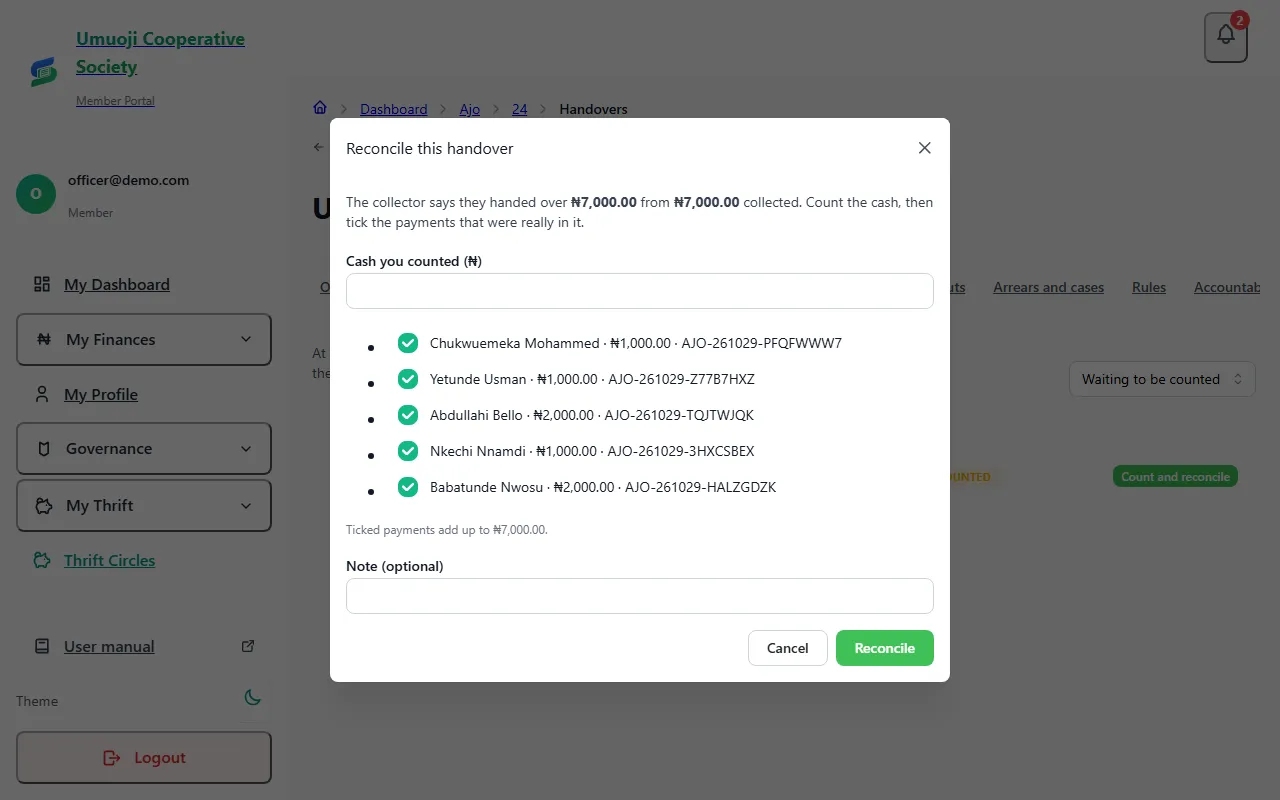
- Counted. An officer counts the cash, and ticks each payment that was really in the bag.
- Confirmed. Every ticked payment becomes Confirmed, is counted in the saver's savings and the circle's figures, and the saver gets a receipt.
Only step 4 changes anyone's savings. Until then the collector's record is a claim, and the officer's count is the check on it.
What the officer sees
The handover compares three numbers:
- Collected: everything the collector recorded that day, plus any cash left over from an earlier day.
- Handed over: what the collector says they gave the office.
- Difference: handed over less collected. Zero means they handed in all of it.
The officer adds a fourth, what they counted. The count has to equal the payments they tick, to the naira. If it does not, SocietyLedger will not save it. This stops a count being typed in that does not match the payments being confirmed.
A worked example
On Friday the collector records cash from five savers: ₦1,000.00, ₦1,000.00, ₦2,000.00, ₦1,000.00 and ₦2,000.00. That is ₦7,000.00 collected.
In the evening the collector hands over ₦6,000.00 and says Chukwuemeka's ₦1,000.00 is still with them, to bring in the morning.
The officer counts ₦6,000.00, ticks the four payments that were in the bag, and leaves Chukwuemeka's unticked. The officer writes a note saying what happened, because the count differs from the payments recorded.
- The four ticked payments become Confirmed and get receipts.
- Chukwuemeka's ₦1,000.00 stays Cash received, awaiting confirmation. It is not lost and it is not counted.
- It is carried over: on Saturday it is added to what the collector collected, so Saturday's handover is ₦1,000.00 higher than Saturday's own cash. When the officer counts Saturday and ticks it, it is confirmed.
If the ₦1,000.00 never appears, the payment stays unconfirmed and shows in the officer's accountability report as cash the office has not seen.
Rules that keep it honest
- The collector cannot confirm their own cash. Someone else, with permission to reconcile, does the counting. A group with only one such person can confirm its own, but must write a note, and it is flagged.
- A note is required whenever a payment was not in the bag or the count differs from what the collector said they handed over.
- A counted handover is final. To correct a mistake, an officer reverses a payment with a reason. Nothing is edited or deleted.
- Cash recorded after a handover for that day is not allowed. The collector hands over once a day, at the end.
- Cash is recorded online. A collector's phone needs internet to record cash or hand it over. Nothing is saved for later, so a payment is never in the app twice or not at all.
Bank transfers
A saver who pays by transfer follows a shorter path. They report the transfer with proof, and an officer checks it against the group's bank statement and confirms it. It is the same idea: a claim, then a check, then confirmed. See Confirming payments.
Why this matters to savers
A saver sees exactly where their cash is: with the collector, handed to the office, or confirmed. It is the answer to "did my money get there?" without having to ask anyone.
Related
Payment statuses
What Paid on time, Reported, Overdue, Missed and the other words mean in a circle, who decides them, and what counts as paid.
Handovers and counting cash
Count the cash a collector hands over, tick the payments that were really in it, and confirm them, including what to do when the count is short.
Handing over at the end of the day
Record how much cash you handed to the office, what the difference means, and what happens if you are short.
Last updated 30 October 2026
Payment statuses
What Paid on time, Reported, Overdue, Missed and the other words mean in a circle, who decides them, and what counts as paid.
Rules, grace and late fees
Set a circle's rules: grace days, late fee, guarantors, what happens if someone stops paying, and what members can see. And how to change them fairly.