

Choosing a circle type
Rotating pot or collector thrift: how the money works in each, who each suits, and the settings you will meet.
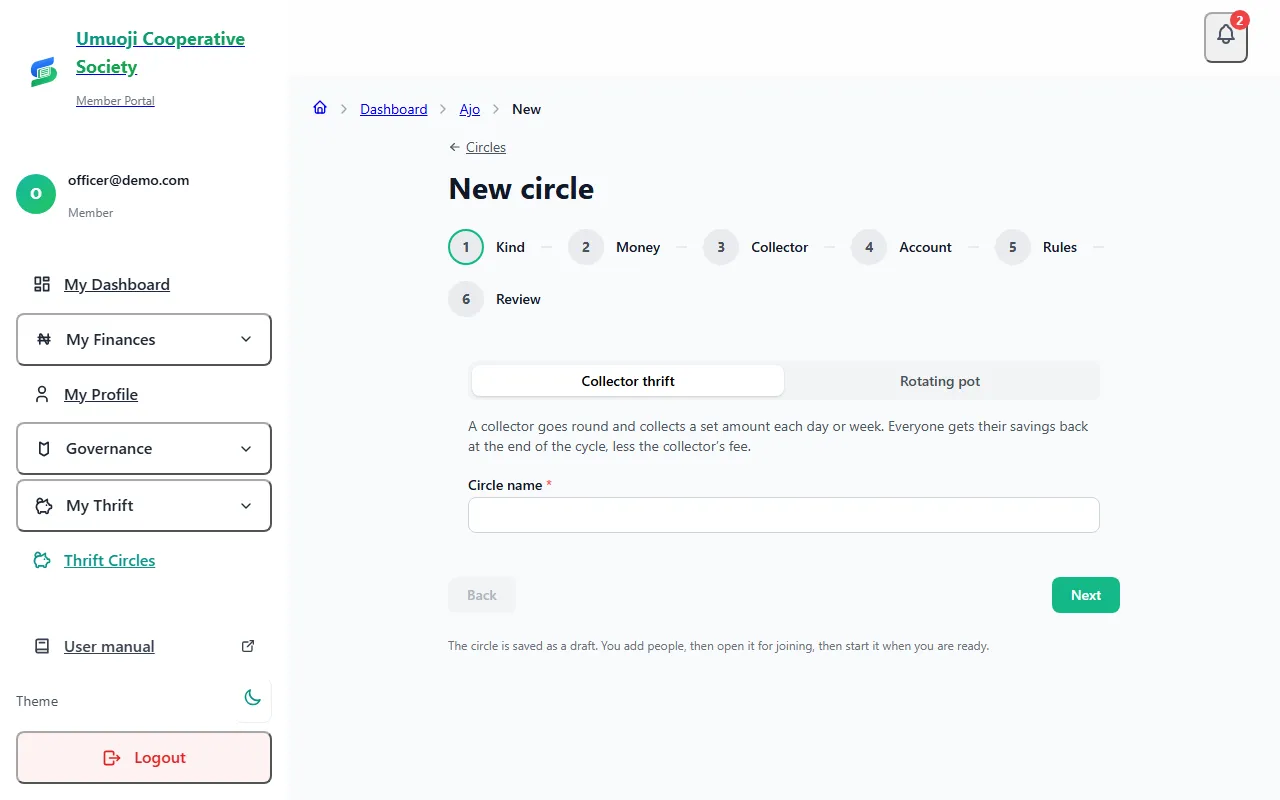
A circle is one savings group inside SocietyLedger. When you create one you choose its type, and the type decides how the money flows, who handles cash and how you run it. You cannot change the type once the circle has started, so it is worth choosing with care.
The two types
| Rotating pot (esusu, adashe) | Collector thrift | |
|---|---|---|
| How the money works | Everyone pays the same amount each round. The whole pot goes to one person each round, in turn, until everyone has had a turn. | Each saver saves a fixed amount a day (or week). At the end of the cycle each saver gets back their own savings, less the collector's fee. |
| Does one person's payment affect another's payout? | Yes. A round's payout depends on everyone paying. | No. Each saver's money is their own. |
| Who handles money | Members pay by bank transfer into the circle's account, and an officer confirms each transfer. | A collector takes cash from savers, usually in a market, and hands it over each day. Transfers also work. |
| What decides who is paid first | A recorded random draw, with a small number of safe changes. | There is no order. Everyone is paid at the end of the cycle. |
| What members see | The Circle board: who has paid, who is next, who is behind. | My savings: their own money, where their cash is, and what they will get back. |
| Needs | Members who trust each other with a shared pot. | A collector, and a place to count cash each day. Includes collector management, from the Growth tier. |
A worked example of each
A rotating pot. Ten market women each pay ₦5,000.00 every Friday. Each Friday the pot is ₦50,000.00, and one woman receives it. After ten weeks everyone has paid ₦50,000.00 in and received ₦50,000.00 back, and the circle is complete. Who goes first was decided by a recorded draw, so no one can say it was arranged.
Collector thrift. A saver gives the collector ₦1,000.00 a day for a 30-day cycle: ₦30,000.00. The collector's fee is set as one day's contribution (₦1,000.00), so at the end the saver receives ₦29,000.00. Another saver who chose ₦2,000.00 a day gets back ₦58,000.00. The circle can also set the fee as a fixed amount, a percentage of what was saved, or none.
Which to choose
- Choose a rotating pot if your group already runs esusu or adashe, with fixed members and a payout in turn, and everyone is happy to depend on each other.
- Choose collector thrift if you are a collector who goes round a market or area, or if each saver wants their own savings back whatever the others do.
- You can run both. An association or a thrift group can have several circles of either type.
Settings you will meet
For both types, you choose a name, the amount each person pays, how often (daily, weekly, monthly, quarterly, yearly, or a custom gap such as every two weeks), the first payment date, and the circle's own bank account where people pay. You also choose the timezone and the cut-off time: a payment after the cut-off counts for the next day.
A rotating pot also has:
- Shares. One person can hold more than one share, which means they take more than one round, and pay for each. By default, a person can hold up to two.
- A draw for the payout order, made once the list of people is final.
Collector thrift also has:
- A cycle length, the number of days or weeks in a savings cycle.
- A collector fee, taken from what each saver gets back.
- Whether people can join after it has started. A late joiner's cycle ends on the same day as everyone else's.
How a rotating pot decides its payout order
A rotating pot also asks how the payout order is decided: an automatic draw (random, recorded, and anyone can check it) or the admin sets the order (placed by hand, with a written reason every member can read). See The payout order and the draw.
What happens next
Once you have chosen, the guide to setting up your thrift group walks through the steps. Then set the circle's rules, grace and late fees before you add people, because each person accepts the rules when they join.
Related
Setting up your thrift group
From a new account to your first circle with its people in it, in about ten minutes.
The payout order and the draw
How a rotating pot decides who is paid when: the recorded draw, shares, swapping places, and emergency changes with a reason.
Savings cycles
How a collector-thrift circle runs in cycles: each saver's own amount, the choice to withdraw or continue, and starting the next cycle.
Last updated 30 October 2026