

Savings cycles
How a collector-thrift circle runs in cycles: each saver's own amount, the choice to withdraw or continue, and starting the next cycle.
A collector-thrift circle runs in cycles: a fixed run of days (for example, 30) in which every saver saves the same amount each time. At the end, each saver chooses to withdraw (their savings are paid to them, less the collector's fee) or continue into the next cycle. This page covers how a cycle works and how to run the end of one.
Before you start
- This page is for collector thrift. A rotating pot has one cycle, its rounds.
- You need the approve payouts permission to start the next cycle. Officers with manage can see the page and record a choice for a saver.
How a cycle works
- Each saver has their own amount. It must be at least the circle's minimum, and the saver (or an officer for them) sets it before the cycle begins. It then cannot change within the cycle, which is what makes a saver's schedule and their final payout certain.
- A late joiner's cycle ends with everyone else's. If someone joins on day 10, they save for the days that remain, and their cycle ends on the same day.
- The collector's fee is set when the circle is created (for example, one day's contribution). It comes out of each saver's savings when the cycle ends.
- Cash is counted day by day. See Handovers and counting cash.
See where the cycle stands
Open the circle and choose the Savings cycle tab.
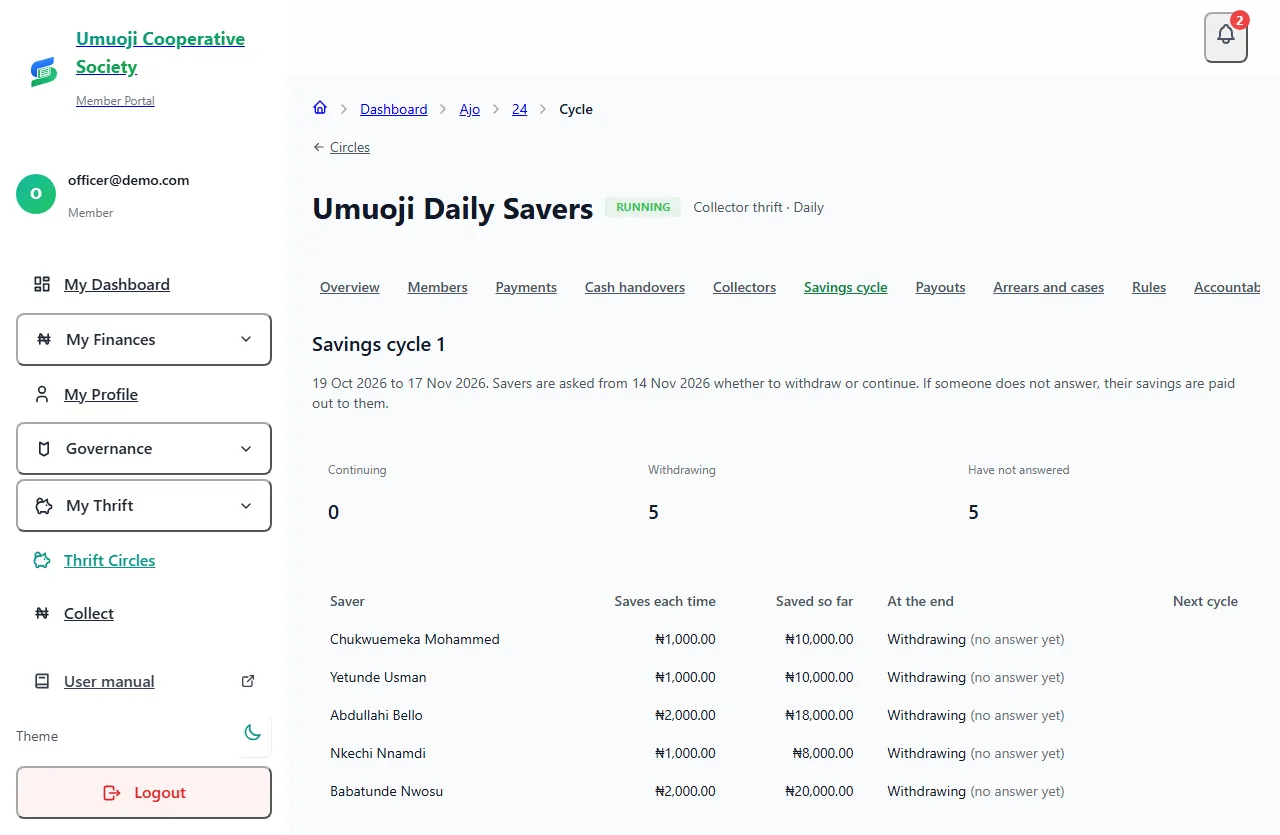
The page shows the cycle's dates, how many savers are Continuing, Withdrawing and Have not answered, and for each saver: Saves each time, Saved so far, At the end (their choice), and Next cycle.
The end of a cycle
Savers are asked three days before the cycle ends whether to withdraw or continue. In the demo above, the cycle ends on 17 November, so savers are asked from 14 November.
- Withdraw. The saver's savings, less the collector's fee, are paid to their payout account. They need a verified payout account before then.
- Continue. The saver stays in the circle for the next cycle, and chooses what to save each time. Any money that has not been paid out is brought forward.
- No answer means withdraw. If a saver does not answer, their savings are paid out to them. This is the safe default: nobody's money is held longer than they asked.
- An officer can record a choice for someone who has no login, and the page shows "(recorded by an officer)".
Savers who withdraw are paid like any payout: an officer prepares it, an admin approves it, and it is recorded as paid.
Start the next cycle
You can start the next cycle only when:
- the current cycle is over, and
- every saver who is withdrawing has been paid (their payout is recorded as paid).
If a withdrawing saver has not been paid yet, SocietyLedger says who, and will not start the next cycle until they have been.
What happens next
Savers see their new cycle on their own page, with their calendar of payments. Past cycles stay under My record, with their totals. Nothing from an earlier cycle is erased.
A saver's amount is a promise to themselves
Fixing the amount for the whole cycle protects savers from slipping: a collector cannot talk a saver into a smaller amount halfway through, and a saver cannot lose track of what they agreed. If a saver needs to change their amount, it changes at the start of the next cycle.
Related
Choosing a circle type
Rotating pot or collector thrift: how the money works in each, who each suits, and the settings you will meet.
Preparing, approving and recording a payout
How a payout is worked out, approved by a second person, paid from the circle's own account and recorded, and what to do if the transfer fails.
Your savings as a saver
If you save through a collector: see every naira you have given, where your cash is, what you will get back, and what to do at the end of the cycle.
Last updated 30 October 2026
Late fees, default cases, repayment plans and disputes
What happens when someone falls behind: how late fees are worked out and waived, how cases and repayment plans run, and how to decide a claim.
Handovers and counting cash
Count the cash a collector hands over, tick the payments that were really in it, and confirm them, including what to do when the count is short.